

Four-stroke cycle
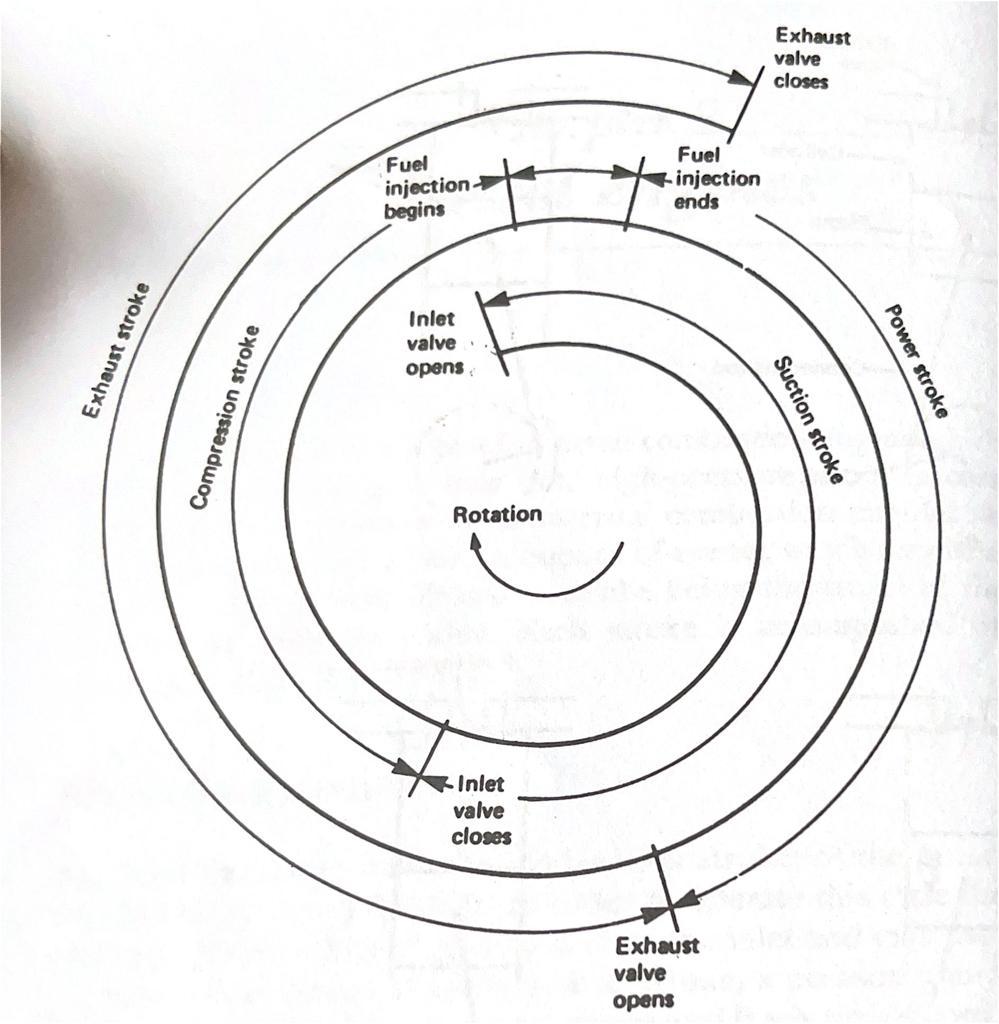
The four-stroke cycle is completed in four strokes of the piston, or two revolutions of the crankshaft.
In order to operate this cycle the engine requires a mechanism to open and close the inlet and exhaust valves.
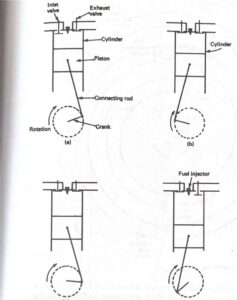
Consider the piston at the top of its stroke, a position known as top dead centre (TDC). The inlet valve opens and fresh air is drawn in as the piston moves down.
At the bottom of the stroke, i.e. bottom dead centre (BDC), the inlet valve closes and the air in the cylinder is compressed (and consequently raised in temperature) as the piston rises.
Fuel is injected as the piston reaches top dead centre and combustion takes place, producing very high pressure in the gases.
The piston is now forced down by these gases and at bottom dead centre the exhaust valve opens. The final stroke is the exhausting of the burnt gases as the piston rises to top dead centre to complete the cycle. The four distinct strokes are known as inlet’ (or suction), ‘compression’, ‘power’ (or working stroke) and
‘exhaust’.
These events are shown diagrammatically on a timing diagram. The angle of the crank at which each operation takes place is shown as well as the period of the operation in degrees. This diagram is more correctly representative of the actual cycle than the simplified explanation given in describing the four-stroke cycle. For different engine designs the different angles will vary, but the diagram is typical.
