

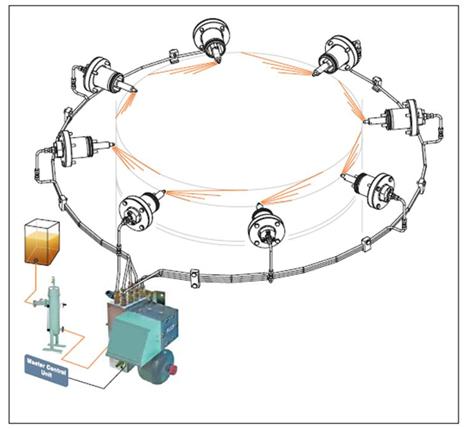
Lubricator
The lubricators are driven by a common drive from the engine it supply cylinder oil to the cylinder. They are synchronized with the engine to provide timed lubrication.
How to arrange to supply oil to cylinder (or) when they supply L.O to engine
Lube oil be fed to the piston at the time when the top two piston rings pass the lubricating holes in the cylinder during the pistons upstroke.
Timed lubrication
♦ Lubricators of each cylinder are synchronised with engine to provide timed lubrication
♦ Cylinder oil is fed; at the time when top two piston rings pass the oil feed points, in the cylinder during piston upstroke [4/S and 2/S Uniflow engines]
♦ Loop scavenge Sulzer RND engine use accumulator system of timed lubrication
♦ Accumulator provides constant oil pressure, which is greater than scavenge air pressure, with uniform supply at every period around TDC and BDC positions.
♦ In this way, oil is delivered to quill, only when low pressure and temperature prevails on running surface of cylinder liner.
♦ 8 supply points at top, and 1 point for scavenge and 1 point for exhaust ports at bottom
Timed lubrication has little merits, because
♦ It requires very rapid injection of oil at correct time, with correct amount, and pressure
♦ It is discharging through very small bore; with long pipes to various oil feed points
♦ Having a non-return valve at the top of lubricator, hence it complicates the timed injection
♦ The hot combustion gases tend to carbonise the oil, and block the orifices.
Lubricator Quill
Lubricator quills are arranged around the periphery of the cylinder liners and connect cylinder lubricators with oil feed points in the cylinder liners.
Requirement of lubricator
♦ Must be capable of delivering regularly every stroke a quantity of oil against moderate pressure
♦ Must have a wide range of adjustment
♦ The quantity of discharged oil per strike should be clearly visible
♦ Can be operated by hand
How do you do lubricator quill overhaul ?
♦ Remove nut on lubricator quill (L.O connector)
♦ Take out lubricator quill fitted directly to the cylinder without passing through the jacket cooling space.
♦ Remove lubricator quill (L.O outlet side)
♦ Take out spring and non return ball valve.
♦ Clean all parts in diesel oil.
♦ Check non return valve for occur.
♦ Check spring tension.
♦ Place the non return valve and spring into the lubricator quill then tighten out.
♦ Fit the lubricator quill to the cylinder tighten the nut.
♦ After fitting the lubricator quill, It is operated by hand at the same time check the cylinder liner wall for sufficient oil come out.
REQUIREMENTS OF CYLINDER LUB OIL
♦ It must reduce sliding friction between piston rings and cylinder liner to a minimum.
♦ It must process adequate viscosity at high working temperature and still be sufficiently fluid to spread rapidly over the entire working surfaces to form a good adsorbed oil film.
♦ It must form an effective seal in conjunction with the piston rings, preventing gas blow by, burning away of the oil film and lack of compression.
♦ It must burn cleanly, leaving as little and as soft a deposit as possible.
♦ It must effectively prevent the build up of deposits in the piston ring zones and exhaust ports.
♦ It must effectively neutralize the corrosive effects on the mineral acids formed during combustion of the fuel.
Effects of excess lubrication:
♦ Fouling of ring grooves and resulting ring zone deposits.
♦ Consequently, loss of gas sealing effect and blow by follows.
♦ Fouling of scavenge space and scavenge fire follows.
♦ Also affecting combustion process.
♦ Leading to breakage of piston rings
♦ Fouling of exhaust system and turbocharger.
♦ Increase consumption.
Effects of reduce lubrication:
♦ Promote wear of liner and rings
♦ Overheating of local area resulting micro seizure due to lack of boundary lubrication.
♦ Consequently major damage to piston and cylinder liner.
How to check correct amount of lubricator feeding ?
Checking by open scavenging drain (little coming out O.K) at sea.
In port: Check the liner is wet or not (thin layer wet O.K)
Oil has to not collect at the scavenge space.
