

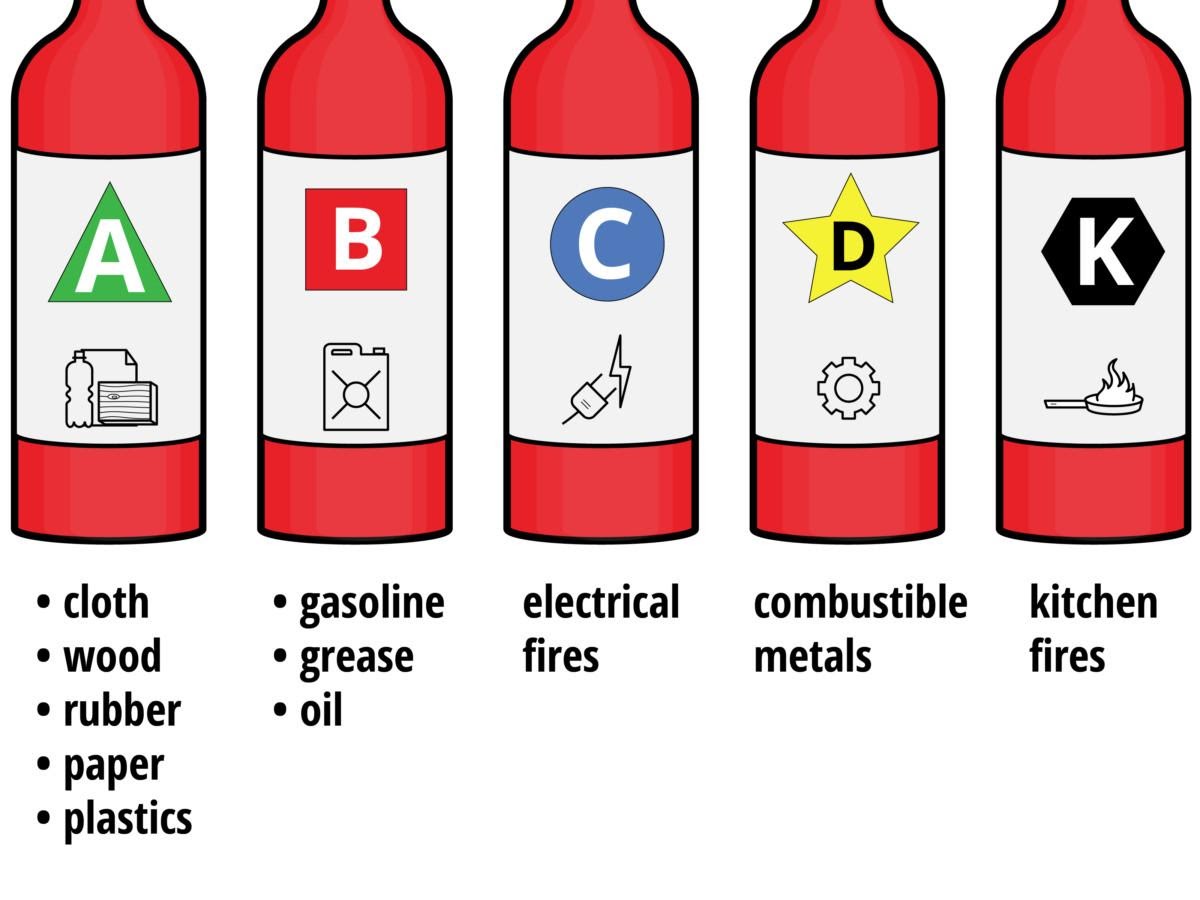
 Classes of fire.
A – Ordinary combustible material.
B – Flammable liquid & gases.
C – Electrical fire.
D – Metal fire.
Types of detector
1. Combustible gas. (Galley, ER fwd bulkhead adjacent to p/p room under floor plate)
2. Heat (Galley, Boiler room, Laundry, control room)
3. Smoke (Machinery space, Cargo space, Laundry, at stairways, corridor, escape route within Accommodation space)
4. Flame (Engine room, near fuel handling equipment)
Fire tetra hedron.
Heat, oxygen, fuel, chain reaction.
Various medium used for fire fighting
1. Water : This is extinguishing mainly by cooling the material at fire. Steam generation is useful for smothering. Water is more suitable against fire in wood, paper and textiles.
2. Foam: The extinguishing effect of the foam is a combination of smothering and cooling. Foam is used against fire in oil surfaces.
3. Dry powder: The extinguishing effect of the powder is mainly by inhibition (change breaking) and effective mainly against fires in flammable liquid, gases and electrical equipment.
4. Carbondioxide: The extinguishing effect is smothering and inhibiting. CO2 is heavier than air, the best condition for extinguishing is in closed spaces. CO2 give no secondary damage. It is electrically non-conductor and therefore suitable against electrical equipment fire.
5. Halon: Extinguishing effect is nearly exclusively inhibition. Halons are suitable against fires in liquid and electrical equipment. All Halons are consider to be toxic to some degree because with hot surfaces and flame causes them to break down yielding toxic substances.
1. How many kinds of extinguishers in E/R ?
There are 3-kinds of extinguishers in E/R. There are foam, CO2, and dry power types.
2. How do operate chemical foam extinguisher ?
It can be operated by releasing the cap by means of operating handle and turning it up side down. Aim to near the fire (base or wall). Shake the bottle foam coming out.
3. How to operate and extinguish the CO2 extinguisher ?
Remove the safety pin and then the valve-operating lever is squeezed to pierce the disc. The liquid CO2 leaves into the discharge horn and emerge as a cloud of CO2.
4. What is emergency fire pump ?
It is a fixed emergency fire pump independently driven by self cooled compression ignition engine or an electric motor which power is supply from emergency generator. All the fire pumps out of action either by disabling the pumps or their source of power, it can be used.
5. Where emergency fire pump in your ship ?
It is fitted at steering flat, shaft tunnel, forward part of the ship.
The pump to be located remote from machinery space.
6. Requirements for emergency fire pump ?
Passenger ships of 1000 grt and upwards and in cargo ships of 2000 grt and upwards must have fixed emergency fire pump independently driven by a self cooled compression ignition engine or an electric motor driven by electric power from emergency generator.
It must be located outside the E/R room, in the steering flat, shaft tunnel or in forward part of the ship.
It must have own suction, total suction head should not exceed 4.5 meters under all conditions of list or trim.
Pump capacity must not less than 25m3/hr and must be able to deliver two ½ inches bore jet of water having a horizontal throw not less than 40 ft.
Fuel tank for engine shall contain sufficient to run on full load for at least 3 hrs and reverse fuel for 15hrs, store outside the machinery space.
The prime mover engine at that unit must be hand started and able to start by one man.
If the pump is fitted above the water level, priming arrangement must be fitted.
If diesel engine driven:
Easily started in cold condition (0C by hand cranking
Fuel tank for engine shall contain sufficient to run on full load for at least 3 hrs and
Sufficient reverse fuel for 15 hrs, store outside the machinery space
If motor driven: emergency power supply heating arrangement
No. of Fire Pump
♦ Passenger ship of 4000 GRT and upward at least 3 pumps
♦ Passenger ship of < 4000 GRT and Cargo ship of 1000 GRR & above at least 2.
♦ Cargo ship of < 1000 GRT according to administration
7. What are the portable fire extinguisher used for? Where are they located ?
Portable fire extinguishers are the first line of defence.
It can be deal with an emergency as prompt action
All extinguishers should be:
01) Locate in an easily accessible Position
02) The correct type to deal with the class of fire expected in that area
03) Painted in the appropriate color code.
04) Regularly inspected and tested.
Water-signal red, CO2 –black, foam- pale cream, dry power- franch blue.
8. Why do you make CO2 room ventilation ? Where ?
To remove the leakage CO2 from the CO2 room .CO2 gas is heavier than air and does not support to human life (Suffocate). (CO2 room must be well ventilated before entry) Outside the machinery space usually at main deck and it must be separated compartment.
9. How to make it ?
It is made by motor driven exhaust blower or fan, which suction is drown from CO2 room floor, because CO2 is heavier than air and leakage CO2 can accumulate on the CO2 room floor.
Fan control switch is fitted outside the CO2 room entrance.
10. How to extinguish control room small electrical fire ?
When E/R control room electrical fire breaks out, we must use CO2 portable fire extinguisher, because CO2 is electrical nonconductor.
01) First give the fire alarm signal.
02) Check the condition of fire and cut out the power if is possible.
03) Shut off E/R ventilator and close the E/R entrance door but one exit door must be opened behind me.
04) Take CO2 portable extinguisher and fight the fire by staying up steam of air and the distance about 3-4 ft from fire.
05) Move back to the exit door.
06) Leave the extinguisher and close the exit door.
Carbon dioxide flooding system.
1) Steel cylinder, 67 liters capacity, each charged with 45 kg liquid CO2 under pressure of 55 bar. Provided with safety disc, bursts at a pressure of 175 to 195 bar.
2) Quick release or total flooding cylinders are arranged that 85% of the capacity can be released within 2 minutes. Can be discharged individually.
3) Manual release cylinders for individual release.
4) Both groups are manifolds together.
5) The liquid when released produces about 450 times its original liquid volume in the gas form. One kg of liquid CO2 can produce 0.56 cubic meter gas.
6) To be effective in smothering a fire the total carbon dioxide gas to be obtained at least 30% of the gross volume of the largest room of the ship and the total flooding system must release to obtain 40% of the gross volume of the machinery space and held until the fire is out.
7) The visual and audible smoke detecting cabinet is located in the wheel house and two exhaust fans are installed in the water tight galvanized steel box on top of it. The three way valves, under the smoke detecting cabinet, are normally closed to CO2 line and the blower sucks air from the holds through smoke detector will be closed and CO2 can be discharged to the required cargo hold.
11. How to release the CO2 gas from fixed instillation to machinery space ?
01) CO2 flooding to machinery space must be done by master’s order.
02) CO2 must be released by competent engineer, CE or 2/E.
03) When cabinet door is opened alarm will sound and all E/R fans will be stopped.
04) Before releasing CO2, all ER crew to be counted (No absence).
05) All openings must be shut (ventilator flaps, fire dampers).
06) All fuel pumps and quick closing valves of fuel tanks and fuel transfer line must be shut from remote control position.
07) After opening the cabinet door, master valve must be opened first.
08) Pull the operating handle of pilot cylinders.
09) CO2 released from pilot cylinders, operate the gang release bar so that all CO2 from quick release or total flooding cylinders will be released to machinery space.
10) By regulation, 85% of the capacity must be able to be released within 2 minutes.
Sprinkler or pressure water
The system consists of several sections comprising a number of sprinkler heads mounted on the pipes, each section being connected through a section control valve to a sprinkler main which in turn is connected to a pressure tank and a pump.
The entire system is initially charged with fresh water at a pressure of about 8 bar by a tank, maintained under pressure by compressed air. It is also connected to an independent sea water pump with its own sea water suction.
Each sprinkler head has a quartzoid bulb which retains a diaphragm seal in the outlet of the water pipe. This bulb is partially filled with a special fluid so arranged that a rise in temperature in the compartment concerned will cause the liquid to expand and entirely filled the space, the bulb burst, the water pressure forces the diaphragm out and water flow out from the sprinkler.
Under the specific pressure of 5 to 8 bar, maintained in the tank by air pressure, the water from the sprinkler is deflected upwards and outwards and broken into a fine spray by the serrated edge of the sprinkler base and will adequately cover a floor area of about 16 square meters.
The resultant pressure drop at the release of the water causes an alarm to sound on the bridge and indicates on the board, the zone in which the ruptured sprinkler heads are situated.
When the system pressure dropped to 5 bar, the sea water pump will start automatically and continue supply with sea water.
Each head must deliver 100 litters per minute. The number of heads in one section is limited not more than 200. They are spaced not more than 4 meters apart and 2 meter from any bulkhead or part of the ship’s side which forms a boundary of the protected space.
Section alarms can be tested individually by test cocks on each section. At least two sources of power must be provided to operate the sea water pump and automatic alarms. The component should be tested weekly.
12. Sprinklers system requirements ?
01) Each sprinkler head must be capable of 100 lit/min.
02) Each sprinkler head is sufficient to cover the area of about 16 square meters.
03) One section is permitted to contain 150 to 200 heads.
04) Sprinkler heads are spaced not more than 4 meter apart and 2 meter from the vertical wall.
05) There must be at least two powers source for the sea water pump, alarm system and FW pump.
06) This system consists of independent S.W p/p with its own sea water suction.
07) Section alarm can be tested individually by test cock on each section.
Mechanical foam.
1) Foam is smothering agent. The production of this foam is mainly a process of agitation of a mixture of water, air and single foam compound, resulting in which is a vast and continuous bubble formation.
2) Foam compound is an aqueous solution of partially hydrolyzed keratin, stabilized with iron salts.
3) With modern foam making nozzles, the mechanical foam constituency can be varied from sloppy to stiff. Stiff foam has only blanketing quality. Sloppy foam has speed of smothering and additional cooling properties.
4) The expansion ratio is 30:1 water to foam compound, producing 200:1 foam to compound.
5) Quantity of the foam to give about six inches depth over the areas to be protected. The duration for the whole capacity discharge should be less than 5 minutes. The foam should not be disturbed too early and reignition may occur from the residual heat.
13. Differentiate between explosimeter and Davy’s safety lamp ?
Explosimeter
To measure the consideration of inflammable gas and vapour in the atmosphere
Quickly and accurately.
It can measure remote from required tank.
It is necessary to skill full for operation.
Based on Wheatstone bridge principle.
No need to handle with care.
Davy’s safety lamp
To detect the tank atmospheres, whether it is explosive gas or fatal gas.
It can get verify roughly the tank is gas free or not.
It is required to apply directly into the required tank.
Based on the ordinary fire process.
No need to highly skill.
But it required careful handling.
Davy’s safety lamp.
Employed for detection of the tank atmosphere whether explosive or containing fatal gases.
1) If the flame in the lamp burn clearly, the tank atmosphere is free from any fatal or explosive gases.
2) If it is develops a faint blue cap above, it is the sign of an explosive gas present.
3) If the lamp burns black or goes out, foul gas such as carbon dioxide is present. The lamp will not burn in an atmosphere containing less than 16% of oxygen.
14. What are LFL and HFL ? Lower flammable limit (LFL)
The concentration of hydrocarbon gas,1% by volume in air below which there is insufficient hydrocarbon gas to support and propagate combustion is Lower Flammable Limit. Higher flammable limit (HFL)
The concentration of hydrocarbon gas inn air 10% by volume, above which there is insufficient air to support and propagate combustion.
It is a highest concentration of hydrocarbon gas in air for explosion.
15. Advantages of inert gas purging system ?
No explosive mixture can form in the tank.
Reduce corrosion.
Reduce pumping time because of the positive pressure in the tank at all the time.
Reduce the fire risk in the event of cargo loading, transporting and discharging.
16. FO setting tank (service) gas free procedure ?
Drain down the entire charge into the double bottom tank through the dumping valve.
When the tank is empty, open the manhole door which located one on top and other on side.
Make force ventilation by blower fan through the manhole door at least 24 hrs.
Then check the tank atmosphere by Davy’s safety lamp.
If the flame burns clearly, the tank atmosphere is free from explosive or fatal gas.
Enter into the tank and clear the sludge and wipe out with cotton rags. During entering the tank ventilation must be provided continuously.
One competent person must stand near the entrance to keep on watch.
Use spark proof torch and lamp. Naked light and smoking not allowed in the vicinity.
Gas free procedure
01) Gas freeing is essential before entering empty. (Gas free certificate, Tank entry permit
02) Manhole doors to be opened for at least 24 hrs before entry.
03) Forced ventilation with air duct, to be done with electric blower for at least 24 hrs.
04) With forced exhausting system, minimum of 2 air changes should be completed during that time.
05) After through ventilation, tank atmosphere tested for any toxic or explosive gases, by invited chemist or with Davy’s safety lamp before entering.
06) When the tank is gas free, the following LSA to be carried or kept ready, when entering,
a. Lifeline or harness to be put on.
b. Spark proof hand torch to be brought in.
c. BA set to be kept ready.
d. Resuscitation equipment to be kept ready.
e. Have rescue team, readily available and properly led.
f. Competent person, stand by at entrance.
g. Agree a communication system, before entry.
h. Have adequate illumination.
18. What precaution to be taken before enter the tank ?
1) Gas free certificate
2) Tank entry permit
3) Davy safety lamp to be brought into and test tank air
4) Breathing apparatus, resuscitation equipment to be kept ready at entrance.
5) Life line to be put on
6) A spark proof hand torch light to be brought in
7) competent person to be kept on watch
8) Smoking and naked light not allowed in vicinity
19. Is there any device onboard to detect any foul gas ?
Davy’s safety lamp is employed for detection of tank atmosphere it is explosive gas or any foul gas such as CO2.
20. How to extinguish E/R bilge fire ?
First check the condition of fire; it is small oil fire in the bilge well.
Then raise the fire alarm signal.
Remove the combustible material near vicinity
It is a small fire, extinguish by foam portable extinguisher. It is operated by releasing the cap the cap by means of operating handle and turning it up side down. Foam will emit from nozzle.
Release the foam direct to the fire by deflecting it from another surface.
Foam is lower specific gravity than oil or water that it will flows across the surface of oil and cover.
The fire will stop by blanking with foam.
21. What are the effects of chemical form ?
The extinguishing effect of the form is a combination of smothering and cooling.
When burning surface is covered with foam, it will insulate the flame from the liquid surface, there by the heat radiation against the liquid is decreased and the gas generation decreased. So that the fire stops.
Foam is used against fires in oil surface.
What is chemical foam safety device ? It function ?
1. Small radial hole at cap
2. Atmosphere valve
The cap has small holes in the threads or also has in the middle of bottle thread so that any internal pressure must be released before the cap is fully removed.
Firstly, unscrew slowly foam will emit, so it cannot injure.
22. What is fixed installation ?
It is a fixed fire extinguishing equipment fitted for engine room and C/H to extinguish the immerse fire controlled by remote station, (Eg. usually mechanical foam or CO2.)
23. How do take action for cabin fire ?
When I found the fire in cabin give the alarm signal.
Check the condition of fire and remove the combustible material near vicinity.
Isolate electrical supply to that cabin.
Take the soda acid or CO2 or foam portable extinguisher from the alley way.
If use soda acid type, remove the safety guard and strike the knob smartly.
Then release the water to the fire spaces.
Give the boundary cooling to it adjacent spaces, if the fire is great.
The fire will stop by cooling effect.
23. Safety devices on CO2 fixed installation system ?
Master valve with alarm switch for cargo hold.
Relief valves at each brunch line
Stop valve and pull handle are in lock cabinet and alarm switch.
Safety bursting disc at each CO2 bottle.
Maintenance of CO2 flooding System
1. Before entry CO2 room must be well ventilated
2. Weekly inspection for alarm system
3. Bottle should be weighted yearly, level checked by ultrasonic or radio active isotope detection. Level reference mark should be provided. If 10% loss of weight, recharge them.
4. All the pulley, wire, rope and toggle must be free from dirt, scales and well lubricated.
5. CO2 branch pipe and nozzle should be cleared with compress air at two year interval
6. Bottle should not be exposed to temperature of 60°C
24. How will you do for cargo hold fire ?
Remote detector fitted at the bridge can detect concerned cargo space.
This operation must be done by master’s order.
After ensuring no person left in cargo space, seal off the cargo space (closing of ventilation fan, fire damper, and hatch cover).
25. Where do you use CO2 A fire extinguisher ?
CO2 fire extinguisher is used in electrical equipment fires.
It is electrically nonconductor.
CO2 is heavier than air but it can be carried away by combustion gases and flame, if it is used out door.
The best condition for extinguishing is in enclosed space.
CO2 is a clean medium and give no residue, therefore it has no secondary damages.
26. What point to be checked after cleaning the FO service tank ?
Check heating coils that is no deformation and burst.
Check bolts and bracket of heating coils and their tightness.
Check magnesium anode.
Check float ball indicator.
Check numerator tank gauge.
Check striker plate wear down.
27. How will you test smoke detector ?
Smoke test- by applying smoke to the detector head, alarm will activate and light up the indicator lamp.
Check the line cleanliness between cargo hold and smoke detector by checking nylon propellers. It must rotate when are clear.
Any blockage can be clear by using compressed air. (Open the 3-ways valve fully, it will contact the CO2 main and cargo hold line and blow with compressed air.)
28. What is the fire control plan ?
It is a general arrangement plan which shall be permanently exhibited onboard for the guidance of ship personal and also exhibited outside the deck house with water tight enclosure for the guidance of shore fire brigade.
It consists of –
1) fire control stations
2) Location of various portable fir extinguisher & FFA.
3) Fire detecting and alarming system.
4) Means of escape.
5) Ventilation system.
6) Fixed fire fighting instillation system.
29. Principle of fire fighting ?
Cooling to reduce the temperature.
Smothering to reduce emission of vapour.
Cutting off combustion material.
Cutting off O2.
Interrupting chain reaction by chemical.
30. What is international shore connection ?
It is a standard size flange, together with bolts, nuts and washers which has a couplings fitted which is suitable for the ship’s hoses. It is used to connect up the shore water main in any port to the ship’s fire main and equipment. (w.pr –10.5 bar )
Material Ý Steel at 1.0 N/mm2 designed
Dimension Ý OD = 178 mm, Ý Flange thickness = 14.5 mm
Ý ID = 64 mm, Ý Slots in flange: 4 holes, 19 mm Φ, equal spacing
Ý PCD = 132 mm, Ý Bolts & nuts: 4, 16 mmΦ , 50 mm length, 8 washers
31. Why fitted emergency fire pump on board ship ?
It is fitted and alternative means of providing water for fire fighting if a fire in any one compartment could put all the fire pumps out of action either by disabling the pumps of their source of power.
32. E/R fire fighting / detecting equipments.
2 no of fire hydrants at each floor.
3 types of portable extinguisher.(CO2, foam, Dry powder) Located in easily accessible position (2 nos. of within 10 m) and correct type to deal with expected class of fire in that area
Non-portable fire extinguisher (136 Litres ( 50 gallons) foam extinguisher for boiler space.)
Sand box with shovel.
Smoke detector and alarm system.
Fixed instillation system.
CO2 SYSTEM REQUIREMENTS
1) Engine room 40% of gross volume, (for < 2000 GRT cargo ship 35%)
2) Safeguard against unauthorized usage
3) Machinery sector valve fitted with alarm and blower trip
4) Operation triggers alarms
5) Permanent piping (up to bilge and tank top)
6) Distribution piping mover than 19 mm diameter
7) Distribution manifold and piping tested 122 bar
8) Copper pipes and high pressure flexible pipes allowed between cylinder outlet valve and manifold
9) Pipes to cargo space not to pass through E/R unless all pipes tested to 122 bar
Requirements of CO2 Bottle
CO2 Properties Limitation
1) All bottles stamped at 52 bar
2) Bursting disc 177~ 193 bar at 63°C
3) Store in temperature less than 55°C
4) Recharge if 5 % loss
5) Clamped against movement and vibration(by wooden plank)
6) Remote and manual operation
7) Hydraulically tested to 228 bar
8) Level tested (by radio active level indication)
9) (if > 10 years internal and external examination required
Cable operated safety valve
Fitted on the pilot cylinder discharge line. It prevents accidental discharge of CO2 from quick release cylinder due to action of leakage gas from pilot cylinder.
Relief valves
Fitted on each discharge line from cylinders so that leakage gas can safely dispose to atmosphere
Check valve
Fitted on connection pipe between each cylinder discharge valve and manifold, so that leakage of one cylinder cannot effect other cylinder.
Bursting disc
Each bottle has a combined bursting disc, which will rupture spontaneously at a pressure of 177 bar at 63°C
Pressure gauge and pressure alarm in the mainfold
Precaution before CO2 operation
1) All personnel to be evacuated and head counted
2) All remote valves to be closed (FO, DO and LO tanks valve)
3) Stop all fuel and lub oil pumps from remote operation
4) Stop all ventilation fans from remote operation
5) All openings, skylights, funnel flaps etc to be closed
6) Open control box to activate CO2 alarm (warning to personal for CO2 release)
Precaution after CO2 operation
For a room where CO2 has been released, take the following cautions without fail.
1) In CO2 atmosphere, you are in danger of suffocation due to oxygen lack. Never attempt to enter into a room filled with CO2 without putting on breathing apparatus. Before entering into the room full of CO2 never fails to put on hose type or oxygen type breathing apparatus. But don’t use activated carbon type mask.
2) The room should be ventilated after fire in the room has been extinguished completely, Enter into the room when it becomes full of fresh air.
3) Even after fire has been extinguished completely, never bring bare flame such as candle light or lighted cigarette into the burnt room, other wise fire may break out again due to explosion of combustible gases, if any.
4) In order to allow persons to get away quickly and safely in case of fire, entrances and exits shall be always kept clear in particular carefully at around CO2 injecting sports.
5) Should a person be suffocated with CO2, bring him into a place of fresh air without delay and practice artificial respiration. Some of the symptoms of suffocation are as follows:
a) Accelerated respiration
b) Accelerated pulsation
c) Debility
6) When extinguishing fire from electrical equipment, turn off power as soon as possible for checking spread of fire and safety.
Safety device on life boat
Mechanical brake (to prevent accident falling)
Centrifugal brake (to control life boat falling speed between 20 to 40 m/min)
Limit switch (to prevent over tightening of rope) (it is fitted arm of davit just before in limit)
Harbour safety pin (for davit)
Windless safety device
Cable stopper (chain stopper, bow stopper)
Overload trip
Hand brake
Slipping clutch for overload prevents any undesirable damage such hull damage due to anchor and rope broke out.
How will you do for cargo hold fire ?
01) If cargo hold (C/H) fire broken out. While the ship is at sea.
02) Smoke detector will give alarm and signal on the bridge. Duty officer will check which cargo holds is broken out of fire.
03) Give the fire alarm
04) To extinguish the fire. Following procedure must be done
05) Check any person left in the cargo hold (Head count all crew). Totally isolate the cargo hold. (Shut cargo hold ventilation, blower and damper) hatch cover, man hold.
06) Fully open the three way valve to that cargo hold, the line to smoke detector is closed and connect the CO2 main line and cargo hold.
07) Then I go to CO2 room and open master valve for cargo hold.
08) CO2 alarm will sound in the cargo hold
09) Check the required amount of CO2 bottle to use for that cargo hold.
10) Then release required CO2 t cargo hold by pulling the wire connected to CO2 to cargo hold by pulling the wire connected to CO2 bottles or open one by one by manually
11) Fire will stop because room atmosphere is smothering by CO2 gas.
Inert gas generator.
1. Special air cooled diesel generator.
2. Washing & cooling boiler flue gas.
Gas ~ N2 85%, CO2 14%, O2 1%
Maintain 75 milli bar above the cargo.
Sprinkler (quartzoid bulb)
Red – 68′ C
Yellow – 79’C
Green – 93’C
Blue – 141’C
Violet – 182′ C