

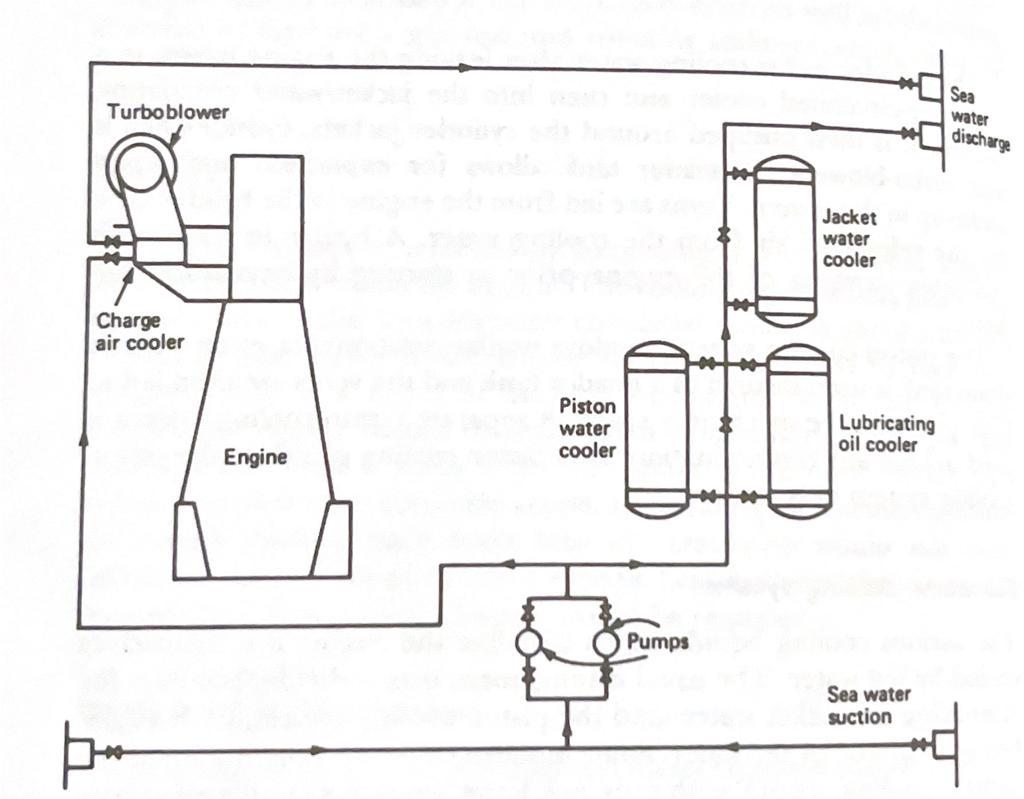
 The various cooling liquids which circulate the engine are themselves cooled by sea water.
The usual arrangement uses individual coolers for lubricating oil, jacket water, and the piston cooling system, each cooler being circulated by sea water.
Some modern ships use what is known as a
‘central cooling system’ with only one large sea-water-circulated cooler.
This cools a supply of fresh water, which then circulates to the other individual coolers. With less equipment in contact with sea water the corrosion problems are much reduced in this system.
From the sea suction one of a pair of sea-water circulating pumps provides sea water which circulates the lubricating oil cooler, the jacket water cooler and the piston water cooler before discharging overboard.
Another branch of the sea water main provides sea water to directly cool the charge air (for a direct-drive two-stroke diesel).
The sea water circuit is made up of high and low suctions, usually on either side of the machinery space, suction strainers and several sea water pumps. The sea water is circulated through the central coolers and then discharged overboard.
A low-temperature and high-temperature circuit exist in the fresh water system. The fresh water in the high-temperature circuit circulates the main engine and may, if required, be used as a heating medium for an evaporator.
The low-temperature circuit circulates the main engine air coolers, the lubricating oil coolers and all other heat exchangers. A regulating valve controls the mixing of water between the high-temperature and low-temperature circuits.
A temperature sensor provides a signal to the control unit which operates the regulating valve to maintain the desired temperature setting. A temperature sensor is also used in a similar control circuit to operate the regulating valve which controls the bypassing of the central coolers.
It is also possible, with appropriate control equipment, to vary the quantity of sea water circulated by the pumps to almost precisely meet the cooler requirements.
