


MAINTAINENCE OF HEAT EXCHANGERS
The only attention that heat exchangers should require is to ensure that the heat transfer surfaces remain substantially clean and flow passages generally clear of obstruction.
Indication that fouling has occurred, is given by a progressive increase in the temperature difference between the two fluids, and change of pressure.
Fouling on the sea-water side is the most usual cause of deterioration in performance. The method of cleaning the sea water side surfaces depends on the type of deposit and heat exchanger.
Soft deposits may be removed by brushing. Chemica cleaning by immersion of in situ, is recommended for stubborn deposits.
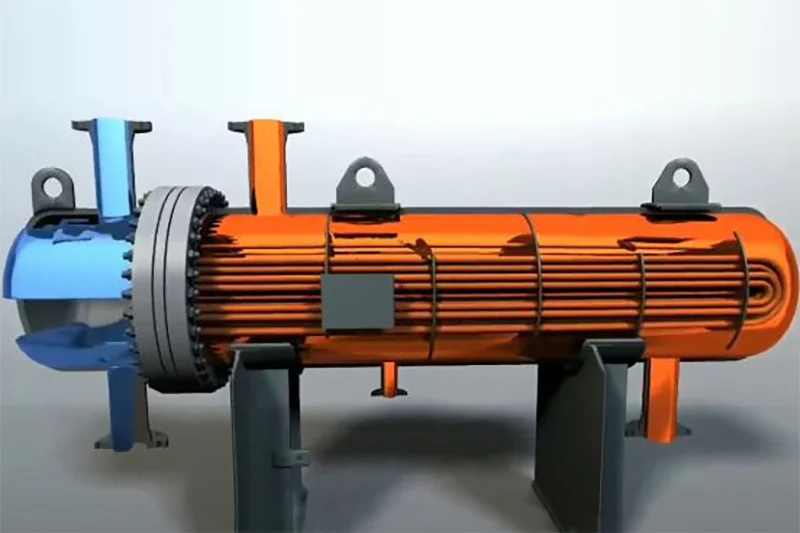
With Shell and tube heat exchangers the removal of the end stvers or, in the case of the smaller heat exchangers, the headers themselves, will provide access to the tubes. Obstructions, dirt and scale can then be removed, using the tools provided by the heat exchanger manufacturer.
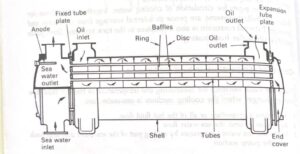
Flushing through with fresh water is recommended before a heat exchanger is returned to service. In oil coolers or heaters, progressive fouling may take place In the outside of the tubes. Manufacturers may recommend a chemical flushing to remove this in situ, without dismantling the heat exchanger.
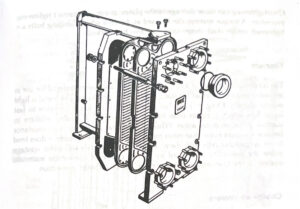
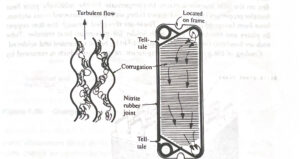
Plate heat exchangers are cleaned by unclamping the stack of plates and exposing the surfaces. Plate surfaces are carefully washed using a brush or dealt with as recommended by the manufacturer to avoid damage. If the plate seals require replacement they may be removed with the method described in the section on plate coolers. Prising seals from their bonding, e.g. with sharp tools. causes plate damage.
Corrosion by sea water may occasionally cause perforation of heat transfer surfaces with resultant leakage of one fluid into the other. Normally the sea water is maintained at a lower pressure than the jacket water and other liquids that it cools, to reduce the risk of sea water entry to engine spaces.
Leakage is not always detected initially if header or drain tanks are automatically topped up or manual top up is not reported. Substantial leaks become evident through rapid loss of lubricating oil or jacket water and operation of low level alarms.
The location of a leak in a shell and tube cooler is a simple procedure. The heat exchanger is first isolated from its systems and after draining the sea water and removing the end covers or headers to expose the tube plates and tube ends, an inspection is made for evidence of liquid flow or seepage from around tube ends or from perforations in the tubes. The location of small leaks is aided if the surfaces are clean and dry.
The fixing arrangement for the tube stack should be checked before removing covers or headers to ensure that the liquid inside will not dislodge the stack. This precaution also underlines the need for isolation of a cooler from the systems.
To aid the detection of leaks in a large cooler such as a main condenser, in which it is difficult to get the tubes dry enough to witness any seepage, it is usual to add a special fluorescent dye to the shell side of the cooler. When an because the dye glows ultra-violet light is shone on to the tubes and tube plates leaks are made visible.
Plate heat exchanger leaks can be found by visual inspection of the plate surfaces or they are cleaned and sprayed with a fluorescent dye penetrant on one side. The other side is then viewed with the aid of an ultra-violet light to show up any defects.
Leaks in charge air coolers allow sea water to pass through to the engine cylinder. This can be a problem in four-stroke engines because there is tendency for salt scale to form on air inlet valve spindles and this makes them stick.
The charge air manifold drain is regularly checked for salt water. Location of the leak may be achieved by having a very low air pressure on the air side and inspecting the flooded sea-water side for air bubbles. Soapy water could be used as an alternative to having the sea-water side flooded.
If a ship is to be out of service for a long period, it is advisable to drain the sea-water side of heat exchangers then clean and flush through with fresh water, after which the heat exchanger should be left drained, if possible until the ship re-enters service.